
The Perfection Trap
Why accepting that perfection is impossible makes inclusion a continuing responsibility.
What would it mean for a company to be perfect at inclusion? Would every employee feel equally understood, every manager respond well to every situation and every policy work exactly as intended? Even in a business with the strongest commitment, the answer could never honestly be yes. People have different experiences, workplaces change and our understanding of what good inclusion requires continues to develop.
Yet organisations are often encouraged to think about inclusion as though there is a point at which the work can be declared complete. A programme is introduced, a policy is updated or an external standard is achieved, and attention begins to move elsewhere. The activity may have been worthwhile, but it can create the impression that the organisation has arrived at a destination rather than taken another step in a much longer process.
That is the real perfection trap – the assumption that flawless is a state that can be reached.
But once we accept that perfection is unattainable, the question changes from whether a company has finished its inclusion work to whether it is prepared to keep doing it.

An aspiration, not an endpoint
In a recent interview with Chris Brookes, Pride365 Founder and CEO Jack Mizel expressed the principle that underpins this approach:
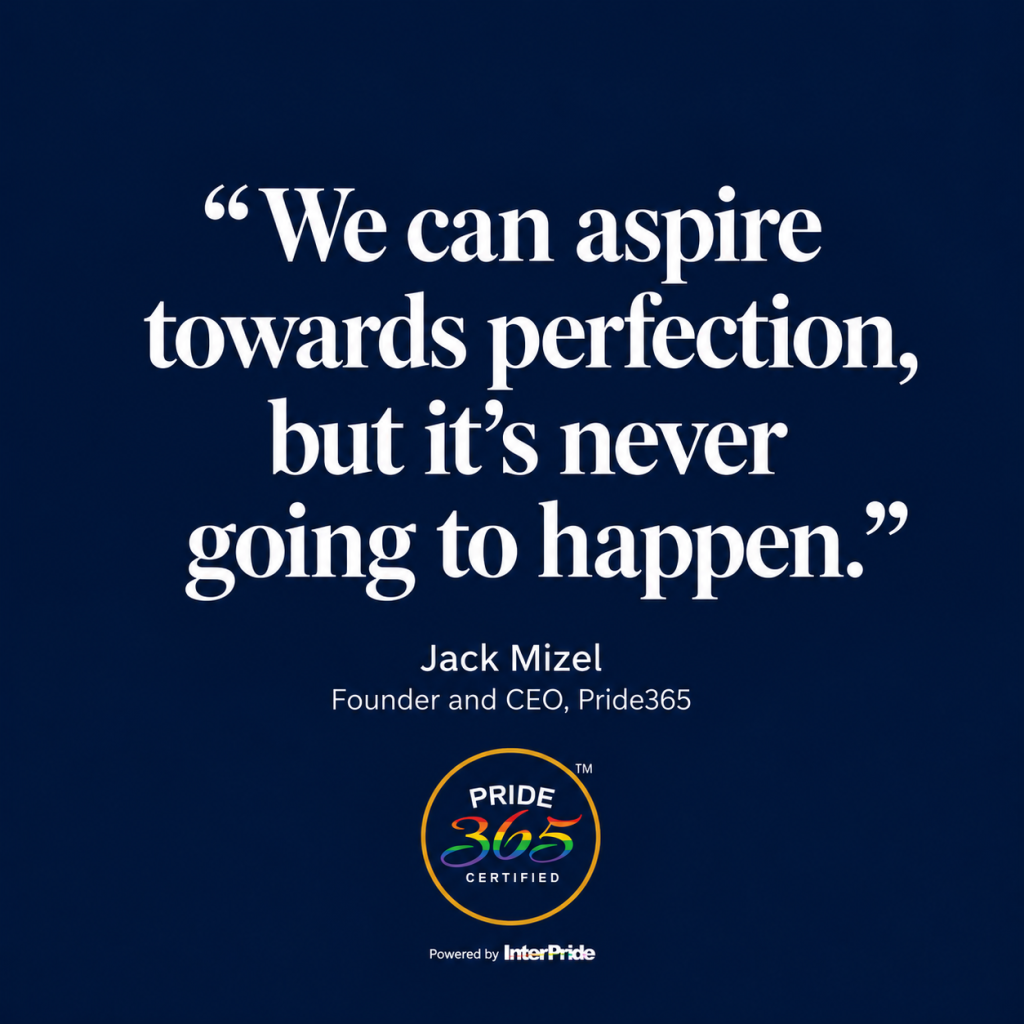
“We can aspire towards perfection, but it’s never going to happen.”
Jack Mizel, Founder and CEO, Pride365
It is an important distinction. Aspiration gives an organisation something to work towards, but an impossible finish point should not become the test of whether the work has succeeded. The reason to set a high standard is to encourage better practice, not to create the illusion that there will come a day when no further thought or effort is necessary.
This matters because the language of achievement can be seductive. Businesses are accustomed to projects with milestones, completion dates and measurable outcomes. Inclusion can certainly benefit from all three, but its purpose is not exhausted when a particular milestone has been reached. A successful training programme does not mean every future manager will automatically understand every employee. An effective policy today does not guarantee that it will continue to meet people’s needs five years from now.
A milestone should tell an organisation what it has achieved so far. It should not relieve it of responsibility for what happens next.
Why the work has to continue
Jack went on to describe how Pride365 assesses a company “at where they are now” and works with it over a three-year period to make incremental improvements. Those improvements are intended to make a difference both in the workplace and in wider society. The timescale matters, but not because three years is long enough to solve inclusion. It matters because meaningful change requires organisations to revisit their decisions and build on what they have learned.
The idea of incremental improvement can sound modest, particularly alongside the bold language that often surrounds corporate commitments. In practice, it demands sustained attention. It asks a company to recognise that its first response may not be its best response, and that what seems sufficient today may need to evolve as circumstances change.
A business may make a significant improvement in how employees are supported and still discover that some colleagues experience the workplace differently. That discovery does not erase the improvement. It gives the organisation a reason to consider its next action. Equally, a company may have been working on inclusion for years without having addressed a problem that has become normalised within its culture. Longevity offers no automatic protection against complacency.
The value of an ongoing commitment is that it creates space for both achievements and uncomfortable findings. Neither should be the end of the conversation.
The danger of believing you have arrived
The greatest risk arises when an organisation begins to believe that its previous work is sufficient evidence of its present culture. It has invested in initiatives, earned recognition and communicated its values, so the subject gradually becomes something it can refer back to rather than something it continues to examine.
This is not necessarily a conscious decision to deprioritise inclusion. It may simply be what happens when a business confuses a record of activity with a permanent result. But a workplace is not static, and the conditions that help one group of employees feel supported may not answer every concern that emerges later.
Recognising that perfection is unattainable should encourage organisations to be curious about their culture, questioning whether earlier decisions are still working and remaining ambitious about what they can improve. The purpose of review is not to uncover failure for its own sake, but to prevent yesterday’s success from becoming an excuse to stop paying attention.

An invitation to keep improving
As Jack explained in his interview, Pride365’s approach is to “invite people in” rather than point fingers. This reflects a belief that meaningful inclusion should be accessible to organisations at different stages, provided they are genuinely committed to making improvements.
Whether working with major businesses such as Hilton and Nissan or smaller LGBT+ owned companies, the principle remains the same. No organisation can claim to have achieved perfection, but every organisation can take responsibility for making a positive difference. That responsibility is reflected in the pledges Pride365 partners make, committing to improvements within their workplaces and contributions to wider society through charitable support and volunteering.
The Pride365 approach allows organisations to acknowledge where they need to improve while making a clear commitment to doing so. The emphasis is not on demonstrating that everything is already right, but on taking meaningful action and continuing to build on it.
The human reason not to stop
One of the most affecting moments in Jack’s interview concerned two Nissan employees who approached him at Pride in London. They explained that when Nissan began working with Pride365, they felt the company cared about them. For the first time in their lives, they felt comfortable beginning their journeys towards coming out, an experience Jack recalled with considerable emotion.
Their story illustrates why inclusion cannot be measured solely by organisational milestones. What mattered to those employees was the difference their employer’s commitment made to their lives. But creating that sense of support is not something a business can achieve once and consider complete. It must remain meaningful for existing employees and for those who join in the future.
Jack spoke about Pride365’s purpose in terms of its impact on people, rather than treating inclusion as simply a corporate exercise. The aspiration to be better should never disappear, even when an organisation has made considerable progress, because the people its commitments are intended to support will continue to have changing experiences and needs.

The Perfection Trap
The real danger of the perfection trap is that it encourages organisations to see inclusion as something they can eventually complete, rather than a responsibility that must evolve alongside the people and communities they support.
Jack’s observation offers a more realistic and ultimately more ambitious perspective. We can aspire towards perfection while accepting that it will never be achieved. We can recognise genuine progress without mistaking it for an ending, and welcome organisations into the process without pretending that participation alone is enough.
For Pride365, inclusion means a continuing commitment to making a positive difference, both within organisations and in wider society. The knowledge that there will always be more to do should not diminish that ambition. It should be what sustains it.
Perfection is not the destination. The responsibility is to keep making things better.