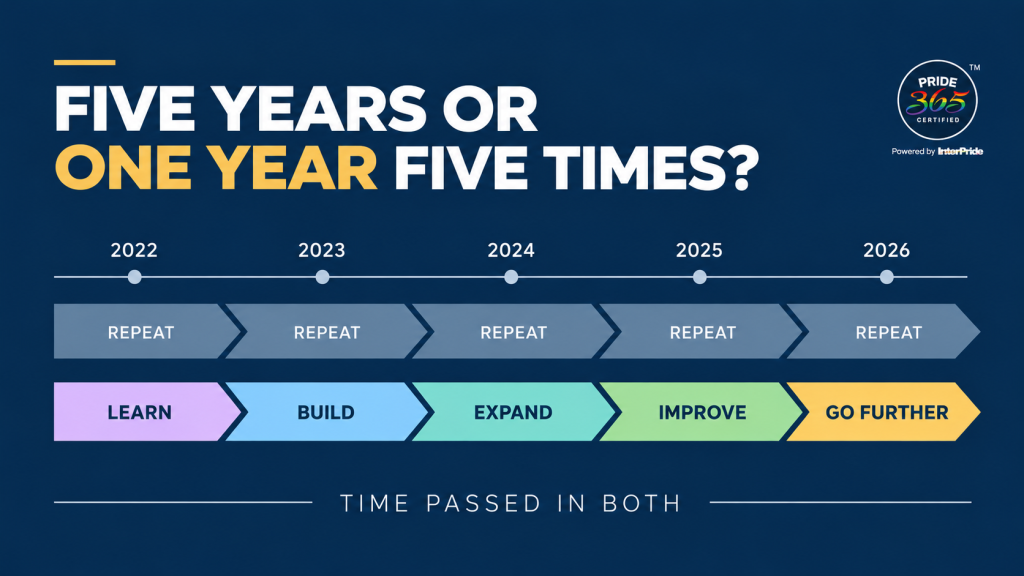
You can spend years working on inclusion and still be standing at the start.
An organisation tells you it has been committed to LGBT+ inclusion for ten years.
It sounds impressive. There may be a well-established employee network, annual Pride activity, policies that have been in place for years and a calendar full of awareness days. However, ask what has actually changed over those ten years and the answer can become surprisingly difficult to pin down.
Because time and progress are not the same thing.
An organisation can spend years doing good things and still be standing close to where it started. The activity continues, the language evolves and another year is added to the story, but the underlying culture, structures and ambitions have barely moved.
That is the standing start. And after many years of assessing organisations through Pride365, it is becoming one of the most useful distinctions we can make.
Corporate inclusion generates plenty of visible activity. Training is delivered, policies are reviewed, employee networks hold events, Pride is celebrated and awareness days are marked. All of those things can have value and consistency itself matters.
The problem comes when activity becomes the evidence of progress rather than the means of achieving it.
Imagine an organisation that runs LGBT+ awareness training every year. After five years, the interesting question is no longer whether the training happened. It is what five years of training changed. Are managers more confident? Do employees know where to go when something goes wrong? Have recurring problems reduced? Has the learning influenced recruitment, customer experience, leadership or policy?
If the answers remain essentially the same year after year, the organisation may have accumulated five years of activity without accumulating five years of progress.
Corporate reporting can make this easy to miss. We count this year’s events, participation and initiatives, then begin another reporting cycle.
The clock resets. Culture does not.
This is where longitudinal assessment becomes important.
A single assessment can tell us a great deal about an organisation. It can identify strengths, expose gaps and establish where the organisation is at that moment. What it cannot tell us is whether anything happens next.
Pride365 was built around that principle. Organisations are assessed and scored, but they are also asked to make specific commitments with dates attached to them. We then return to those commitments and look at what was delivered, what changed and what the organisation needs to tackle next.
Over several years, this creates something far more useful than a collection of individual scores. It creates a trajectory.
Nissan Motor GB shows what that can look like in practice. First Pride365 Certified in 2021, the work did not stop at certification. A Pride Network was built and tested, then relaunched by the Managing Director in 2026, while the commitment spread further across Nissan, including Sunderland and into the dealer network. Each stage created a new starting point for the next. That is a trajectory, not a standing start.
That is the part of certification that interests us most. Not simply: what score did you get? But: what did you do with what you learned?
Suppose a first assessment identifies that an organisation’s policies need work. The organisation commits to reviewing them and does so.
But when we return, the existence of those improved policies should no longer be treated as the ambition. They are now part of the baseline.
The next conversation can move further into the organisation. Are managers applying those policies consistently? Do employees understand them? Are people confident about reporting concerns? Is the employee network properly supported? Does inclusion extend into customer-facing environments?
This is what genuine multi-year progress looks like. Previous achievements become the platform from which the next piece of work begins. Over time, the standard rises.
“Progress should turn yesterday’s ambition into today’s baseline.”
Jack Mizel, CEO, Pride365
That is a very different model from the annual reset, where the same activities continue to be presented as evidence that an organisation is moving forward.
The beginning of an inclusion journey can actually be the easier part. When the gaps are obvious, there is plenty to do. Policies can be written, networks created, training introduced and leadership commitments made. Progress can be relatively visible because the distance between having nothing and having something is easy to demonstrate.
The harder stage comes later.
Once the foundations exist, improvement becomes less obvious and often more demanding. The questions move from do you have it? to does it work? From did people attend? to did behaviour change? From do you have a network? to does that network have influence?
This is where an organisation can remain for years. It has enough activity to look credible and enough infrastructure to demonstrate commitment, but the next level requires closer examination of culture, consistency and impact.
Maintaining good practice matters. But it cannot become the reason an organisation stops asking what comes next.

When we renew a pledge for a Pride365 partner, we have something we did not have the first time: history.
We know what the organisation previously told us. We know where it scored strongly and where it did not. We know what it publicly committed to doing and the timescale it set itself.
That changes the nature of the conversation. If something was identified as a weakness previously, we can ask what happened. If a commitment was made, we can look for delivery. If an area improved, we can ask what became possible as a result.
Longitudinal assessment also allows progress that might otherwise be overlooked to become visible. Cultural change is not always dramatic. Sometimes a series of smaller changes, viewed over several years, tells us far more than any individual annual report.

There is a particular risk for organisations that have been working in inclusion for a long time.
Experience creates confidence. The organisation knows the language, has established processes and can point to years of activity. It may genuinely have done valuable work. But longevity can also make difficult questions easier to avoid.
When an organisation says it has supported LGBT+ inclusion for ten years, our response should not simply be to applaud the ten years. We should be interested in what those ten years produced.
What can an LGBT+ employee do today that they could not do then? What has become easier? What has become safer? Which weakness no longer appears in the assessment because it was actually resolved? Where has the organisation deliberately raised the bar for itself?
And what is it still talking about that it was talking about five years ago?
That final question can be uncomfortable. It is also incredibly useful.
Every organisation needs a starting point. Pride365 works with organisations at very different stages and being early in the journey is not a failing. Recognising where you are and beginning the work is progress in itself.
The standing start is different.
It is what happens when an organisation has years of inclusion activity behind it but cannot demonstrate meaningful movement from one year to the next. It is when experience becomes a substitute for improvement and repetition starts masquerading as consistency.
This is why we do not want certification to capture an organisation at one flattering moment in time. We want to know what happened before that moment and what happens after it.
Several years of data allow us to ask a much better question than how long have you been doing this?
How far have you moved?
Because an organisation can spend ten years working on inclusion and still be close to the starting line.
The years tell us how long you have been there. Progress tells us whether you moved.