The question is what remained once it was over.
An organisation can deliver an award-winning Pride campaign and still leave an LGBT+ employee unsupported on a Tuesday in September.
That is not an argument against Pride campaigns. It is an argument against expecting a campaign to do something it was never designed to do.
Let us be fair first. Over the last decade, organisations became genuinely better at visible support. Pride Month became a fixture, campaigns became more thoughtful, leaders became more visible. That progress is real and none of it should be sneered at. Visibility matters, and for many people, seeing their employer publicly support the community still means something.
But by September, the rainbow logo has gone, the events have finished, and the communications team has moved on. The decisions that shape whether someone belongs have not. A colleague is still deciding whether to mention their partner in conversation. A manager is still choosing whether to challenge a comment. Someone is still weighing whether reporting discrimination is worth the personal risk.
Those moments never appear on a campaign plan. They are the moments that define culture.
Here is what changed, and why this argument is urgent rather than philosophical. Brand support for the LGBT+ community has fallen from 16% to 9% in three years. The community watched brands arrive loudly and leave quietly, and it learned. June signals are now discounted on sight, because June is when support is cheapest to perform.
One member of staff at a newly certified partner, Bowel Cancer UK, put it in a sentence when asked why their employer certified:
“It’s not quite the same as the rainbow logos we often see popping up around Pride Month, which swiftly disappear on 1 July.”
That is an employee describing the market’s new pricing of trust. A month of visibility now buys almost nothing, because everyone can afford a month. What cannot be performed is a year, repeated.
Campaigns are episodic because marketing is episodic. Culture is continuous because people’s lives are continuous. Confusing one for the other is the most expensive mistake in corporate inclusion.

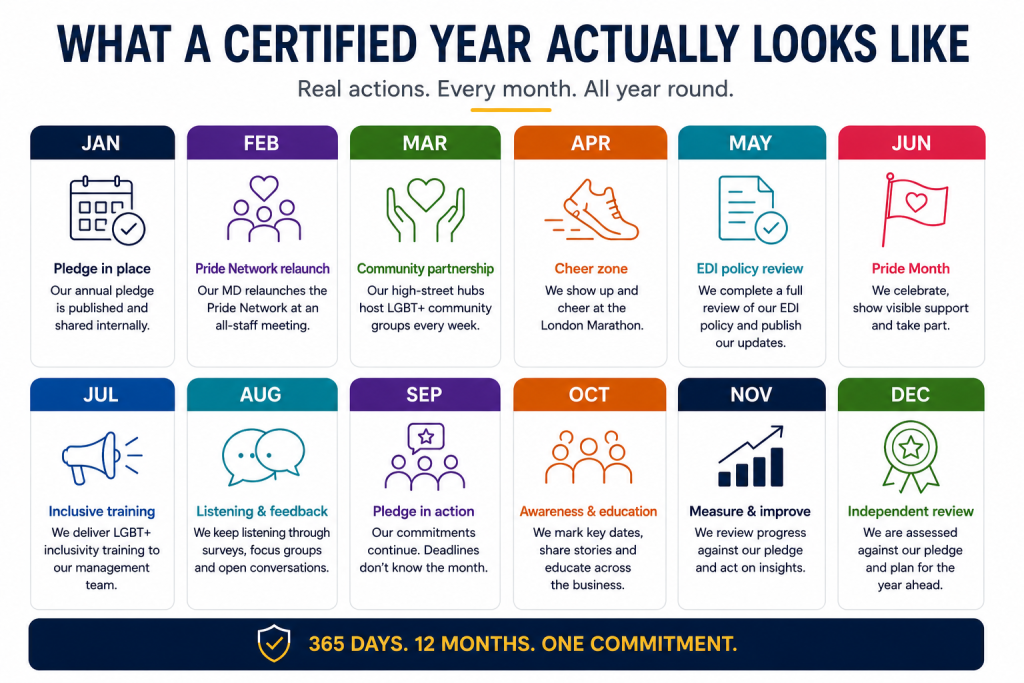
The alternative to a campaign is not more communication. It is a calendar. Here is what 365 looks like in practice, drawn from our certified partners’ actual year, not a brochure.
In December, a motor dealership delivers LGBT+ inclusivity training to its management team. In February, a global carmaker’s Managing Director personally relaunches the company’s Pride Network at an all-staff meeting. In April, there is a cheer zone at the London Marathon.
Through spring, an energy company’s high-street hubs host community groups, as they do every week of the year. In May, that dealership completes a full review of its EDI policy, five months after certifying, each action dated and checkable.
In summer, yes, there is a march, and it matters. In the autumn, commitments made in public pledges keep being delivered, because the deadline in a pledge does not know what month it is. And once a year, every partner is reviewed against the commitments it wrote itself.

None of this generates the visibility of a June campaign. Collectively, it determines whether the June campaign meant anything.
The receipts run long. Nissan Motor GB has held certification since 2021, through three different Managing Directors, and then funded its spread across its plants and dealer network. Hilton, certified since 2021, extended its commitment from Europe into Australasia during the exact years most brands retreated.
Nissan’s first certified Managing Director called Pride365 the company’s North Star: the fixed point that keeps inclusion consistent when the calendar moves on. Nobody renews year after year, through leadership changes, for a logo.
“What’s important is that you have the dialogue. As close as we think we are to the space, we need to be closer, and that is what you can deliver.
There are tweaks and adjustments that need to be made, there are sensitivities we need to be aware of, of course, and that for me is really valuable because we don’t want to go down a specific trajectory and end up finding that the North Star has shifted.”
Andrew Humberstone, former Managing Director, Nissan Motor GB
A certified partner’s leader, filmed while marching with us at Pride in London this year:
“Pride is an amazing month of June. We celebrate it very happily. But support, being there for our colleagues and educating people, is a full-time deal for us. And that means all year round.”
And from Smiths Motor Group, a certified dealership, in their own five-month reflection:
“When you visit our dealerships during Pride Month, you may not see Pride flags flying outside… We believe actions and experiences carry more weight than short-term symbolism.”
Notice what both are saying. Neither rejects Pride Month. Both refuse to let it stand in for the other eleven months. That distinction is the entire certification.
This is why we talk about permanence rather than perfection. No organisation has completed the work of inclusion, and none ever will. Cultures evolve because people evolve. The measure of commitment is not whether an organisation has reached a perfect destination, but whether it is still moving when public attention has moved elsewhere.
So the most revealing question a leadership team can ask at the end of Pride Month is not whether the campaign was successful. It is whether anything will be different because it happened.
Will the conversations continue after the posters come down? Will leaders ask the same questions in November that they asked in June? Would someone joining in January experience the values the campaign promised in June?
If yes, the campaign was the beginning of something.
If no, the organisation has invested more in demonstrating inclusion than in embedding it.

An organisation can deliver an award-winning Pride campaign and still leave an LGBT+ employee unsupported on a Tuesday in September.
The question was never whether the campaign mattered.
The question is what remained once it was over.
That is the case for 365.